July 15, 2026
Gifts to frame: marriage certificate, commemorative documents and special life moments
July 15, 2026
Gifts to frame: marriage certificate, commemorative documents and special life moments
When we look at a painting or a photograph, we rarely think about the importance of the frame in our perception. Its shape, texture, colour - and, especially, direction of profiles. Does the frame go Forward and highlights the work, or Resign and let art breathe - this is one of the most important questions facing professional artists, designers and anyone who wants to frame their work with taste. How do I choose the right profile for my artwork?
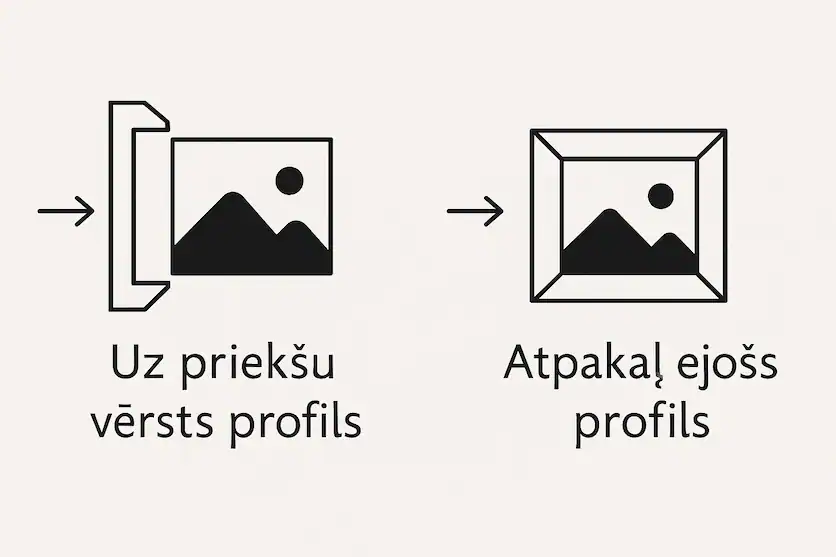
Frame profiles with a progressive shape Forward (i.e. rising up from the side and facing the viewer), gives the feeling that the artwork is "coming out" of the wall. Such frames visually reinforce the composition and give it importance and drama. These types of frames are perfect for: for classic portraitswhere the image and presence of the human being is key, for paintings with darker backgrounds or depthwhere the frame helps to "open up" the image to the viewer, iconographic works or symbolic images that seek to emphasise a central theme. They also work great in interiors with a strong architectural linewhere there are high ceilings, massive materials and a need for visual counterweight.
Profiles that move back (i.e. the frame recedes inwards, as if to draw the gaze towards the painting) have the opposite effect - they draws the viewer into the work of artrather than highlighting the frame. It is a subtle, deeply aesthetic solution that gives the composition peace, breath and depth. These types of frames are ideal for for landscapeswhere perspective and a sense of spaciousness are important, for abstract paintingswhere they don't want competition with the frame, for minimalist interiorswhere the frame becomes a quiet but elegant backdrop. These frames also fit perfectly modern gallery wallswhere light and shadow play a major role, and the frame becomes an extension of the composition rather than a boundary.
The direction of the frame also influences how the artwork interacts with light. The forward-facing frame catches the light superficially, creating shadows and contrasts that give the work a theatrical quality. A backward profile, on the other hand, allows the light to glide more gently, like looking into a window leading to a landscape.
It can be said that Forward-facing profile is like a stage - the frame plays alongside the work, Backwards profile is like a window - the frame only shows the direction, but doesn't interfere. The direction of the frame profile is important because it determines how the viewer perceives the work of art - whether the gaze is directed towards the painting itself, or whether the frame becomes part of the overall composition. When chosen correctly, the direction of the profile helps to bring out the character of the work: it can add depth and drama or, on the contrary, create a calm, balanced mood. In addition, the direction of the frame also influences how the artwork fits in with the surrounding décor and lighting, so this detail has a significant impact on both the aesthetic and emotional impact.
How to choose? Choosing between these two profiles is a creative process. There is no right or wrong answer - it all depends, what you want to reinforce. If you want the viewer to feel the energy of the painting immediately, choose a forward-facing profile. If you want to let your gaze sink in, breathe and contemplate - a backward profile is your choice.
Our EVIART Frames in the design studio we often say: a frame is not just a shape - it is continuation of the dialogue between artist and space. That's why we choose each frame with a sense of balance between the work, its story and the place where it will live.
